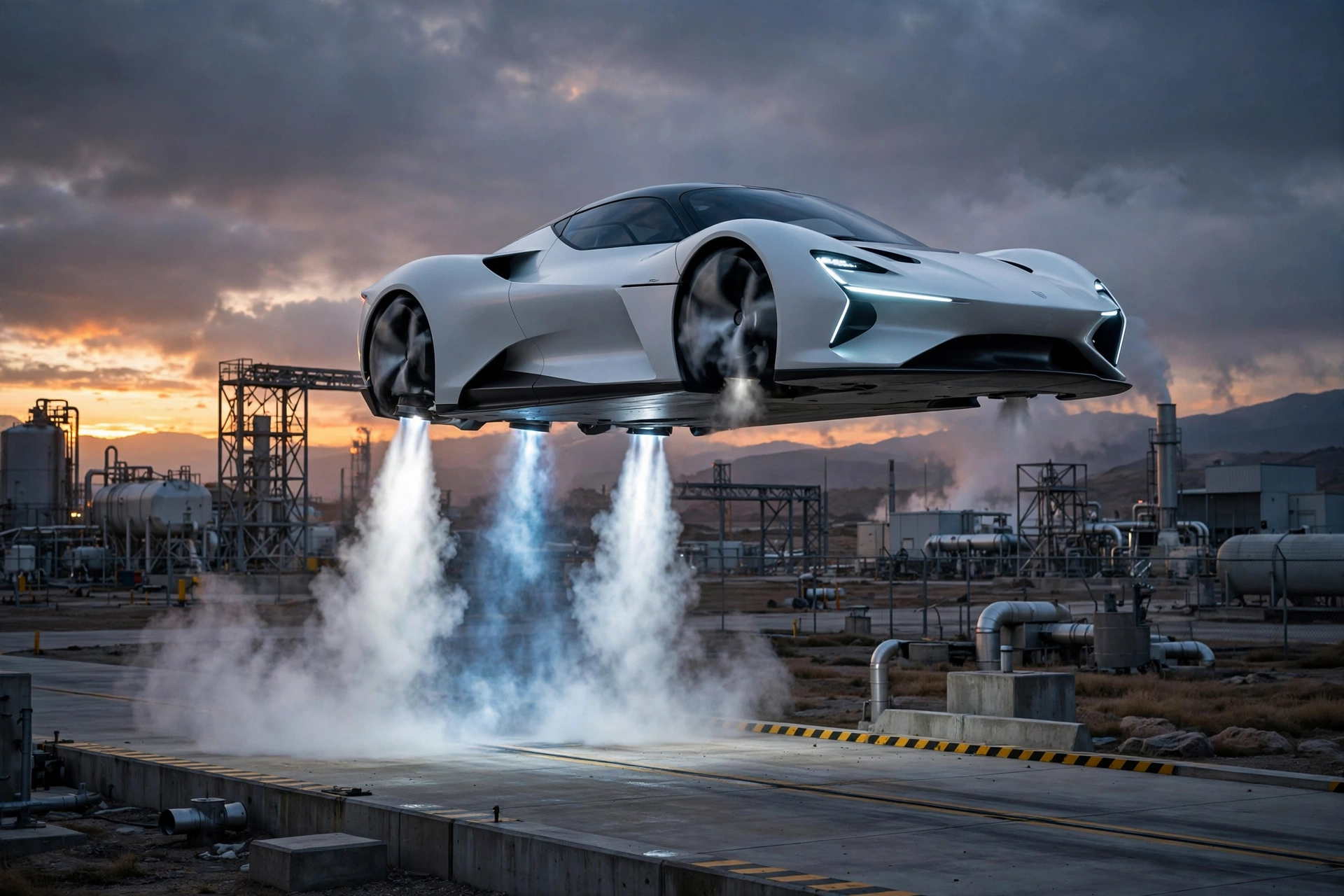
Elon Musk has done it again. On Thursday, October 15, 2026, Tesla unveiled what the company calls a flying car — a new version of the long-delayed Tesla Roadster fitted with SpaceX rocket thrusters that can literally lift the car off the ground.
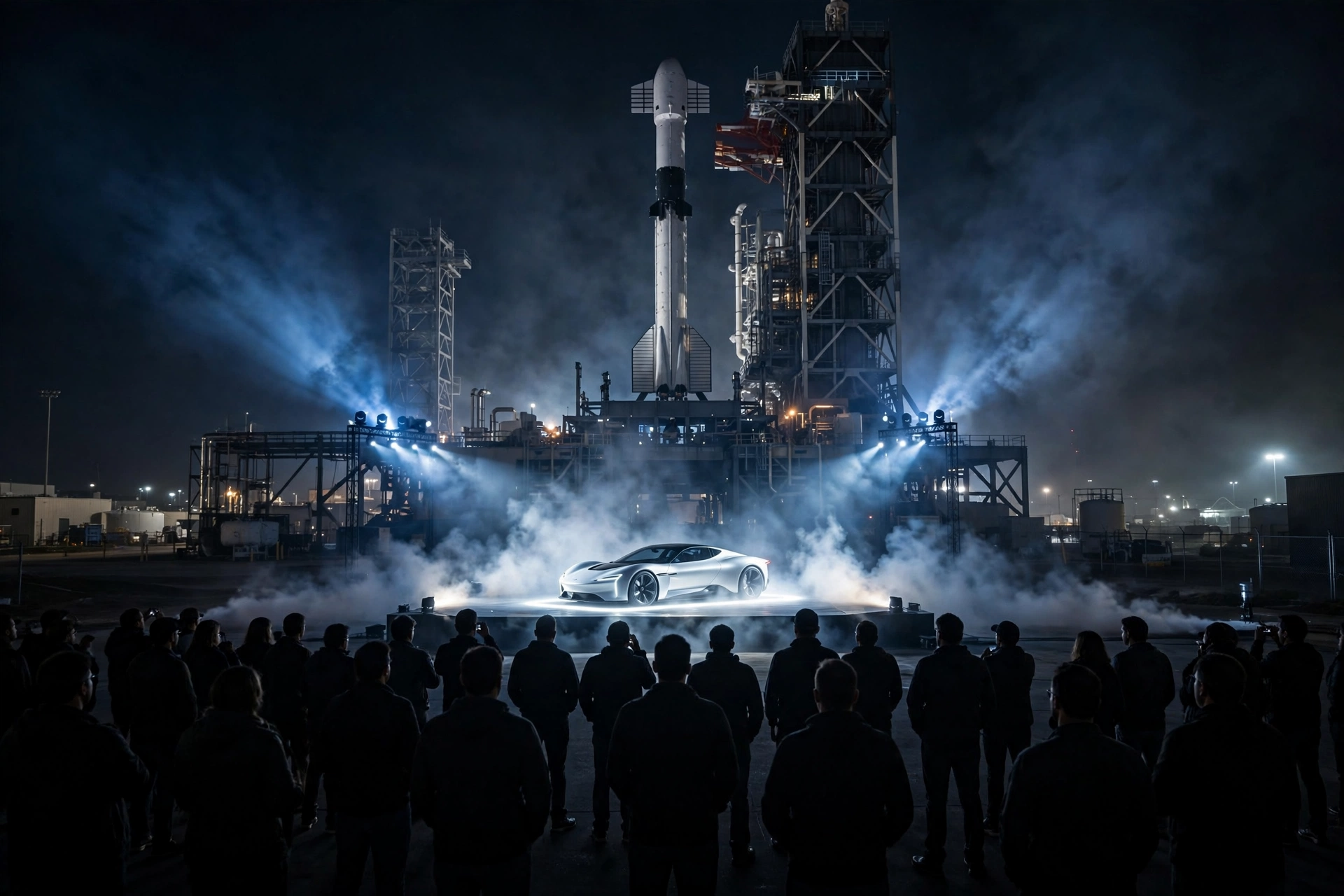
The reveal took place at a SpaceX test facility in McGregor, Texas, where Musk showed off the two-seater sports car in a livestreamed demonstration that left the audience — and the internet — stunned.
What Happened at the Unveiling
The demonstration was pure science fiction made real. The white two-seater Roadster drove up a steep curved ramp — and kept going, ending up driving upside down, held to the surface by a powerful suction system underneath the car. Then it launched off the ramp, performed a full barrel roll in mid-air, and landed softly on its wheels using built-in air thrusters.
Later in the show, the Roadster used the same thrusters to leap clean over a line of parked Tesla vehicles — and even a truck — twisting in the air as it flew.
Notably, there was no driver in the car during any of this. “To make sure we don’t kill anyone,” Musk told the crowd, adding with characteristic candor: “Success is not guaranteed. I mean that. It’ll probably work, but if it doesn’t work, we’re at a safe distance.”
How Does the “Flying” Technology Work?
The Roadster carries 10 cold-gas thruster nozzles fed by ultra high-pressure air tanks — technology adapted directly from SpaceX. According to Tesla, the tanks hold around 250 kilograms of air and can recharge themselves, so no special refueling equipment is needed.
The system works in two ways. A “multi-mode” suction system vacuums the car to the ground, letting it corner at up to 2G and even drive upside down on a ramp. The thrusters then provide the lift — firing to fling the car into the air for short flights, spin it mid-air, and cushion the landing.
The same thrusters also supercharge straight-line performance: Tesla says the Roadster rockets from 0 to 60 mph in under one second (0.8 seconds, per some reports) and can exceed 230 mph flat out.
Musk described the project as “the results of what happens when you have a collaboration with the world’s best car company and the world’s best rocket company.”

What Musk Said
“Flying cars are real,” Musk declared during the event. Shortly after, he posted on X: “Turns out the future does have flying cars.”
He was upfront that the Roadster is “not necessarily a safety-optimized car,” but insisted it will be “an actual car that’s on the roads.” On legality, he was candid: “I’m not sure it’s necessarily legal in all jurisdictions, but there will be such a car that someone can own.”
The Roadster’s Long Road: Nine Years of Waiting
The flying Roadster didn’t come out of nowhere — it’s the payoff of one of Tesla’s longest-running sagas. The second-generation Roadster was first revealed in November 2017, when Musk promised 0–60 in 1.9 seconds, a 620-mile range, and deliveries starting in 2020. None of that happened on schedule.
Over the years, the car became a running joke among Tesla watchers — endlessly teased, repeatedly delayed, with Musk periodically promising it was “coming next year.” The SpaceX thruster package was first floated back in 2018, when Musk tweeted about a “SpaceX option package” with cold gas thrusters. Eight years later, that tweet has become a real car that really flies — at least in short bursts.
The original 2008 Roadster, Tesla’s first production car, was itself a long shot: a $100,000+ electric sports car built on a Lotus Elise chassis, launched when most analysts gave Tesla little chance of survival. It sold about 2,450 units and proved EVs could be desirable — the foundation everything since was built on.
When Can You Buy It — and For How Much?
Musk said the Roadster will go into production in 2028. But Tesla fans have heard this song before, and Musk’s timelines have a well-documented habit of slipping by years.
Tesla did not announce a price at the event. When the car was first shown in 2017, the company quoted a $200,000 base price. This time, Tesla’s website is taking reservations for two versions — a “Performance” model and a “Thrust” model with boosted thrusters — with the final sale price still undisclosed.
The Catch: Don’t Expect to Fly to Work
Before you start planning your commute above the traffic, the fine print matters. Tesla’s own website notes that the rocket/thruster feature is “not approved for public road use.” Regulators on the ground — and in the air — have a lot to say before anyone flies a car over a city, and aviation rules for such vehicles barely exist.
Some observers also noted the timing: the spectacle doubles as a showcase for how deeply Tesla and SpaceX now overlap, amid Musk’s long-discussed idea of merging the two companies he controls.
The Bigger Race: Who Else Is Building Flying Cars?
Tesla isn’t alone in chasing the sky. A whole industry of eVTOL (electric vertical takeoff and landing) aircraft has raised billions: Joby Aviation and Archer Aviation in the US are working to certify electric air taxis, while China’s XPeng has shown off its own flying car concepts. What’s different about Tesla’s approach is that the Roadster is a car first — a road-going sports car that happens to be able to jump.
Regulators, though, are the real gatekeepers. Aviation authorities like the FAA have no framework for a car that sometimes flies, and road safety agencies have none for thrusters on public streets. Until those rules exist, the flying Roadster will remain a track toy for the ultra-rich — albeit an extraordinary one.
Market Reaction
Investors loved the show. Tesla shares jumped nearly 5% in premarket trading on Friday, adding roughly $80 billion in market value — more than the entire market cap of Ferrari. The stock settled to about a 1.3% gain shortly after the open.
Is It Really a “Flying Car”?
Strictly speaking, what Tesla demonstrated is closer to spectacular jumping than sustained flight — short, thruster-powered hops rather than cruising through the skies. But it’s still the first time a production-intent car from a major automaker has demonstrated controlled airborne maneuvers, and it moves the flying-car conversation from renderings to reality.
FAQs: Tesla Flying Car
Did Tesla really unveil a flying car?
Yes — on October 15, 2026, Tesla unveiled a new Roadster with SpaceX cold-gas thrusters that demonstrated short flights, mid-air flips, and upside-down driving at a Texas event.
How does the Tesla flying car fly?
It uses 10 thruster nozzles fed by ultra high-pressure air tanks, plus a suction system that grips the car to surfaces. The thrusters lift it into the air for short hops — not sustained cruising flight.
When will the Tesla Roadster be available?
Musk says production begins in 2028, though Tesla has missed Roadster deadlines before — it was first teased in 2017 with a 2020 delivery target.
How much will the flying Tesla Roadster cost?
No price was announced. The 2017 quote was a $200,000 base price. Tesla is taking reservations for “Performance” and “Thrust” models.
Is the flying car street legal?
Not currently — Tesla’s website states the thruster feature is “not approved for public road use,” and regulators have yet to weigh in.
Disclaimer: This article is based on Tesla’s October 15, 2026 unveiling event as reported by CNN, USA Today, Barron’s and other outlets. Specifications, pricing and the 2028 production timeline are Tesla’s claims and may change. This post is for informational purposes only.