
Ali Khamenei Funeral | Complete Guide to Iran’s Historic Six Day Ceremony
The world is preparing to witness one of the most extraordinary state funerals in modern history. The Ali Khamenei funeral ceremonies are officially scheduled to begin on July 4, 2026, nearly four months after the Iranian Supreme Leader was killed in a joint US-Israeli airstrike on February 28. From Tehran to Qom to Iraq and finally to Mashhad, the six-day journey of Ayatollah Ali Khamenei to his final resting place is expected to draw tens of millions of mourners and representatives from over 90 countries. Here is the complete story from beginning to end.
Ali Khamenei Funeral | Six Day Ceremony Starting July 4
The Ali Khamenei funeral is officially confirmed to run from July 4 to July 9, 2026, spanning multiple cities across Iran and extending into Iraq at the request of Iraqi tribes, scholars and political figures. The Ali Khamenei funeral date July 2026 was announced after months of delays that began almost immediately following his assassination on February 28, with security concerns, ongoing war conditions and unresolved questions about his burial location all contributing to the unprecedented postponement.
The funeral was originally scheduled for March 4 to 6, 2026, just days after Khamenei’s death was confirmed, but was postponed as the US-Israeli war on Iran escalated. Iranian officials cited the impossibility of holding a safe mass gathering at the height of active military conflict as the primary reason for the delay. The Ali Khamenei funeral date July 2026 announcement finally came on June 2 when Iranian officials and state media confirmed the full multi-city schedule, ending months of intense public speculation about when and where the ceremony would take place. Authorities are now preparing for what could become the largest public gathering in the history of the Islamic Republic.
How Was Khamenei Killed | The February 28 US-Israeli Airstrike
Before understanding the scale of the Ali Khamenei funeral, it is essential to understand how he died. Ayatollah Ali Khamenei, 86, was killed on February 28, 2026, during the opening hours of a coordinated joint military operation carried out by the United States and Israel. The strikes targeted his residence in central Tehran using strategic location intelligence reportedly provided by the CIA. Satellite imagery confirmed severe damage to his compound following the attack.
The strikes also killed several of Khamenei’s family members including a daughter, son-in-law, daughter-in-law and grandchild. Senior military commanders were among the other high-profile casualties of the same operation. Iranian state media confirmed his death through the Islamic Republic of Iran Broadcasting on March 1 at around 5:00 AM local time, triggering 40 days of national mourning and seven days of public holidays across Iran. The assassination marked the beginning of what became known as the 2026 Iran War, one of the most significant military conflicts in the Middle East in modern history. It is against this deeply turbulent backdrop that the Ali Khamenei funeral is now finally taking place, with Iran and the US currently observing a fragile ceasefire signed on June 17, 2026, which opened a 60-day window for final diplomatic negotiations. The Mojtaba Khamenei new Supreme Leader designation was made on March 8 when Khamenei’s son was elected as Supreme Leader by the Assembly of Experts, though he has not appeared in public since sustaining serious injuries in the same February attack that killed his father.
Funeral Schedule City by City | Tehran Qom Iraq and Mashhad
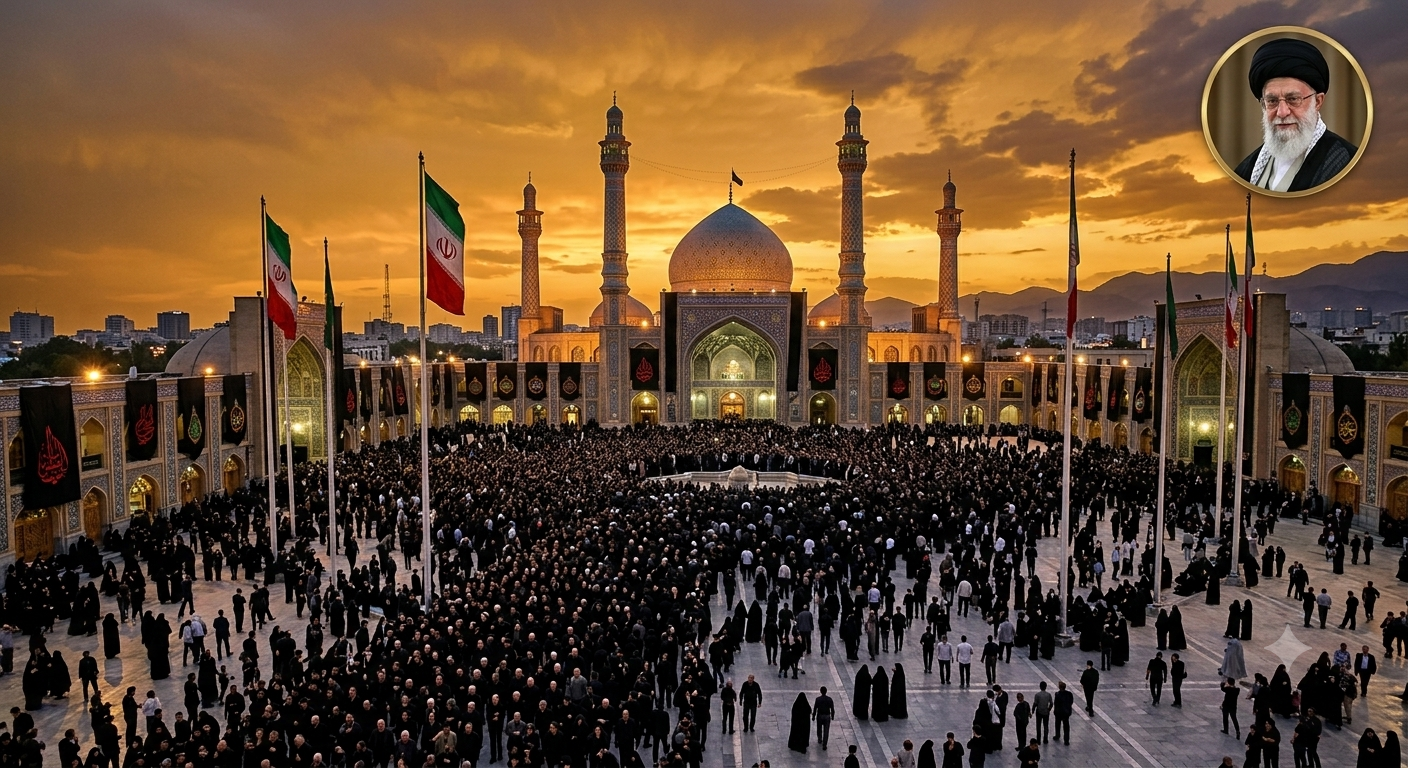
The Iran funeral procession Tehran Qom and beyond follows a carefully planned multi-city route over six consecutive days. Here is the complete schedule. July 4 and 5 in Tehran: The body will lie in state at the Imam Khomeini Grand Prayer Grounds, known as the Mosalla, in central Tehran. The public farewell begins at 6:00 AM on July 4 and continues until 8:00 PM, with funeral prayers scheduled for the morning of July 5. July 6 in Tehran: The main funeral procession will take place along a 10-kilometre route from Imam Hossein Square to Azadi Square, the iconic public space that has hosted the defining mass gatherings of Iranian history since the 1979 revolution.
July 7 in Qom: The Iran funeral procession Tehran Qom continues to the holy city of Qom, where ceremonies will run between the shrine of Fatima Masoumeh and Jamkaran Mosque, one of the most sacred pilgrimage sites in Shia Islam. July 8 in Iraq: At the formal request of Iraqi tribes, scholars and politicians, the procession will cross into Iraq for ceremonies in the holy cities of Najaf and Karbala before returning to Iran. July 9 in Mashhad: The final stage of the journey will see Khamenei laid to rest at the Imam Reza shrine in his hometown of Mashhad. The Khamenei burial Mashhad Imam Reza shrine selection was confirmed by Iranian state media, making his final resting place one of the holiest sites in all of Shia Islam, located at the shrine of the eighth Shia Imam.
20 Million Expected in Tehran | Largest Funeral in Iranian History
The sheer scale of attendance expected at the Ali Khamenei funeral date July 2026 ceremonies is staggering by any measure. Tehran’s mayor has publicly stated that approximately 20 million people are expected to attend the ceremonies in the capital city alone across July 4, 5 and 6. Nationwide attendance across all Iranian cities hosting events is estimated at approximately 35 million people, a figure that would make this one of the largest public gatherings in human history.
Authorities have declared a total of five public holidays across the three Iranian cities hosting the main events to help manage crowd movement and ensure public safety. The Iranian government has also announced plans to nominate the funeral ceremonies for inclusion on the national list of intangible cultural heritage, reflecting the historic significance of the occasion. Iranian officials have confirmed that representatives from more than 30 countries have formally requested to attend the official foreign dignitaries ceremony scheduled for July 3 in Tehran, while religious leaders and scholars from more than 90 countries have expressed their intention to participate in some capacity across the six-day programme.
Pakistan and World Leaders Attending | Shehbaz Sharif Confirms
The Pakistan delegation Khamenei funeral has been officially confirmed at the highest level. On June 19, Prime Minister Shehbaz Sharif publicly stated that Pakistan’s delegation will attend the Ali Khamenei funeral in Iran, reflecting the strong bilateral ties between the two neighbouring Muslim-majority nations. Pakistan’s attendance sends a significant diplomatic signal given the complex geopolitical context surrounding Khamenei’s assassination and the ongoing fragile ceasefire between Iran and the United States.
The Pakistan delegation Khamenei funeral joins a growing list of confirmed international attendees. India confirmed it will send Bihar Governor Lt Gen Syed Ata Hasnain alongside Minister of State for External Affairs Pabitra Margherita. Georgia confirmed attendance through its President Mikheil Kavelashvili. Russia, China, Syria and Lebanon are all anticipated to send senior representatives. The July 3 foreign dignitaries ceremony in Tehran will serve as the formal international gathering point ahead of the main public ceremonies beginning on July 4, allowing world leaders and diplomatic delegations to pay their official respects in a more controlled and secure setting.
Who Is Mojtaba Khamenei | Iran’s New Supreme Leader Explained
With the passing of Ayatollah Ali Khamenei the question of succession became immediately critical for Iran’s political future. The Mojtaba Khamenei new Supreme Leader transition happened relatively quickly despite the chaos of the ongoing war. On March 8, 2026, just eight days after his father’s death was confirmed, Mojtaba Khamenei was elected as the new Supreme Leader of Iran by the Assembly of Experts, the body of Islamic scholars constitutionally responsible for appointing and overseeing the Supreme Leader.
The Mojtaba Khamenei new Supreme Leader appointment however has been shrouded in uncertainty and controversy since March. Mojtaba was seriously injured in the same February 28 airstrike that killed his father and has not made a single public appearance since. No audio or video recording of the new Supreme Leader has been released by Iranian authorities. His health status remains officially undisclosed, sparking widespread speculation both inside and outside Iran about whether he is in a condition to fulfil the duties of the Supreme Leader role. Whether he will attend his father’s funeral ceremonies on July 4 to 9 remains one of the most closely watched questions surrounding the entire event.
For more trending global and Pakistan news, visit pakified.com. Read our latest coverage on trending stories at pakified.com. Follow us on Instagram and X (Twitter) for live updates as the Ali Khamenei funeral ceremonies unfold.